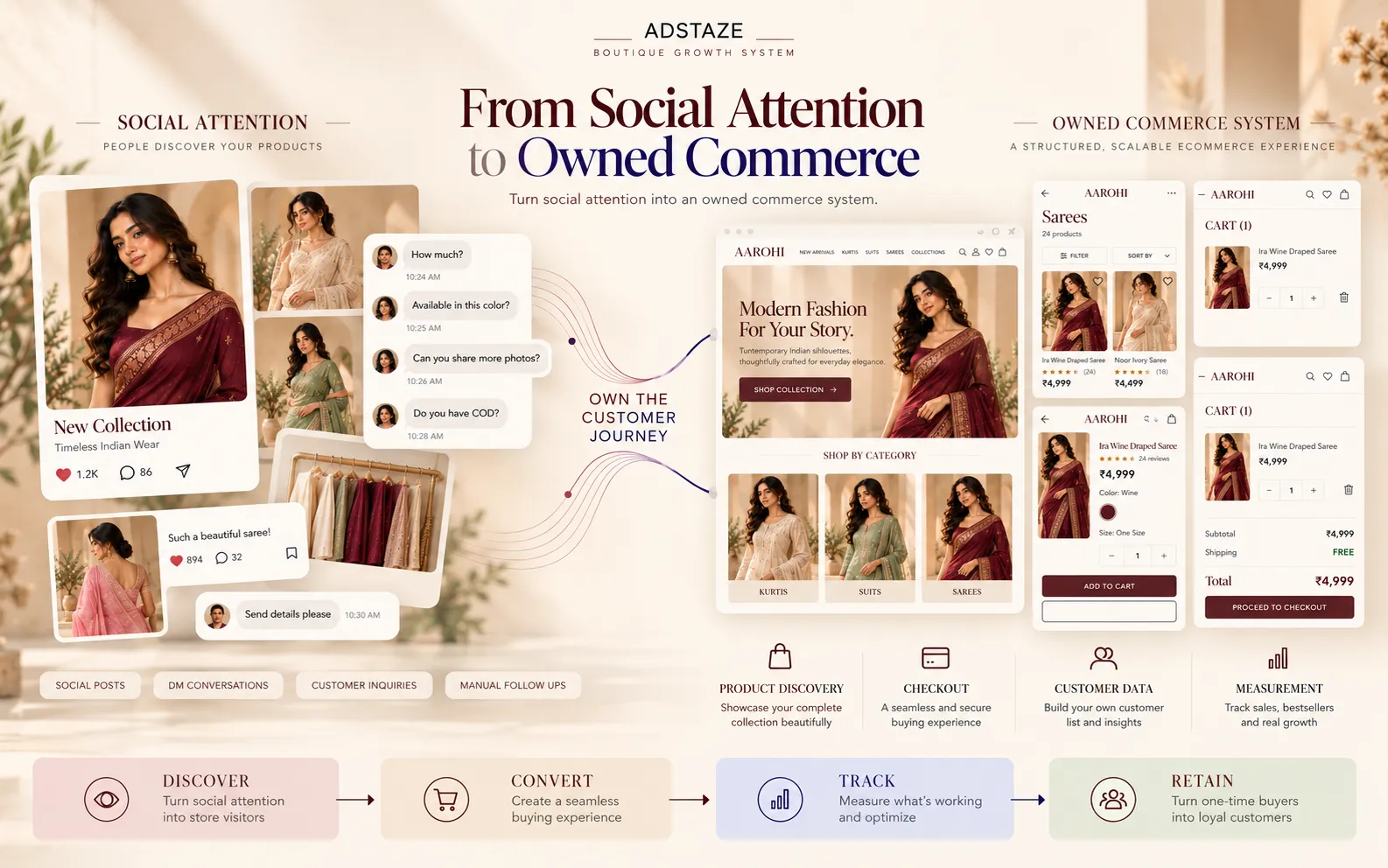
We build mobile-first Shopify storefronts designed to turn Instagram, WhatsApp and offline attention into a structured, measurable customer journey.

Instagram, WhatsApp and offline referrals can create interest — but the customer journey often ends there.
A dedicated storefront gives that attention somewhere to go, while creating the foundation for measurement, acquisition and repeat commerce.
Your Instagram can create the attention. Your storefront should give that attention somewhere to go.
We structure the journey from discovery to product exploration, checkout and post-purchase — so your boutique is not dependent on conversations alone.
From the first product discovery to the final purchase, every important touchpoint is designed around how Indian boutique customers actually shop.

A storefront should not just look premium. It should make the next step obvious.
So the shopping experience should be designed around the phone first — not adapted to it later.
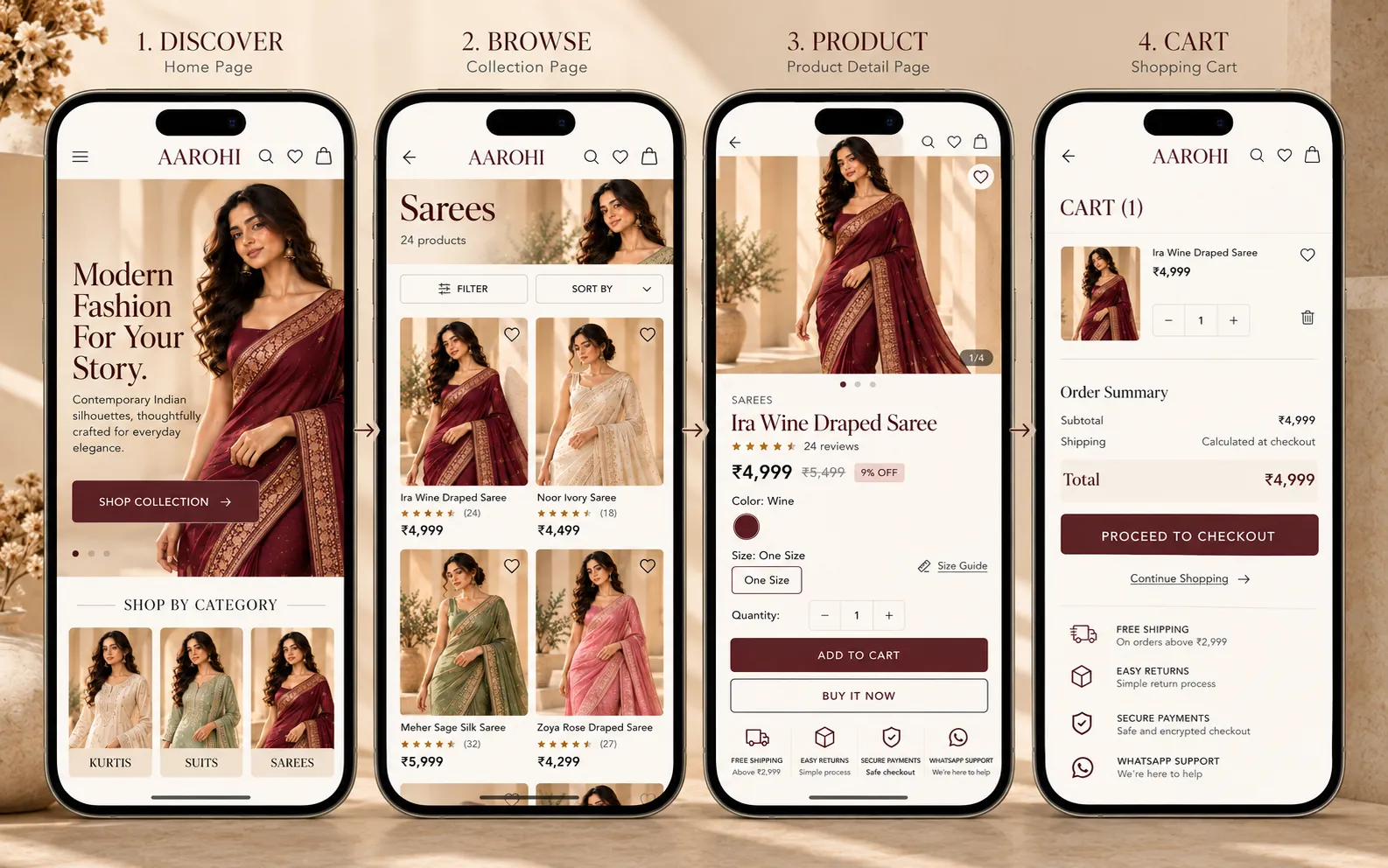
A customer lands from Instagram, WhatsApp or another acquisition channel.
Clear categories, product discovery and mobile-friendly navigation.
Product information, imagery, variants, sizing and trust signals help the decision.
Cart, payment and checkout complete the journey with less friction.
Your storefront needs more than beautiful product pages. It needs the essential pieces that help a customer move from product interest to a completed order.
The goal is not simply to put your catalogue online. It is to create a usable commerce system around it.
Your storefront should be ready for the next stage: bringing qualified traffic in, understanding what happens after the click, and improving the journey over time.
Products, variants, collections and structured product information create a usable foundation for future acquisition workflows.
Important customer actions can be structured around the storefront journey so performance can be measured instead of guessed.
The store becomes a destination for people who discover products through campaigns but don't purchase on the first visit.
Once traffic and customer behaviour can be observed, the storefront can evolve based on evidence rather than assumptions.
A focused Shopify implementation for boutiques that want a professional owned commerce channel — without turning the project into a never-ending website build.
Homepage, collection, product, cart and standard content/policy structure.
Responsive layouts designed around product discovery and shopping behaviour.
Products, variants, collections and structured catalogue presentation.
Payment, COD, shipping and relevant storefront configuration.
Store structure prepared for traffic, measurement and future acquisition workflows.
Final QA, walkthrough and handoff so you know how the store is structured.
Not a generic website package. A focused commerce implementation.
A defined implementation scope keeps the project focused, predictable and easier to launch.
Homepage + core storefront structure
Collection + product detail pages
Cart + standard checkout flow
Defined product catalogue setup
Mobile-first responsive implementation
Payment, COD + shipping configuration
Standard policy/content templates
Final QA + launch handoff
Unlimited products or catalogue uploads
Unlimited revisions or new page requests
Photography, video production or shoots
Full branding, naming or identity creation
Custom apps, headless or Shopify Plus work
ERP, PIM or warehouse integrations
Ongoing ads, SEO or social management
Shopify, domain, app, gateway or courier fees
Timeline starts after required product information, imagery, policies and access are available.
Two revision rounds keep feedback structured instead of turning the project into continuous redesign.
New functionality or work outside the agreed scope is handled separately before implementation.
A defined implementation process keeps the project moving without unnecessary back-and-forth.
Scope confirmation, access, content review, store architecture and initial implementation setup.
Storefront pages, catalogue structure, responsive experience and relevant commerce configuration.
Final checks, consolidated revisions, launch preparation, walkthrough and store handoff.
Timeline begins after scope approval, required access, content lock and third-party onboarding.
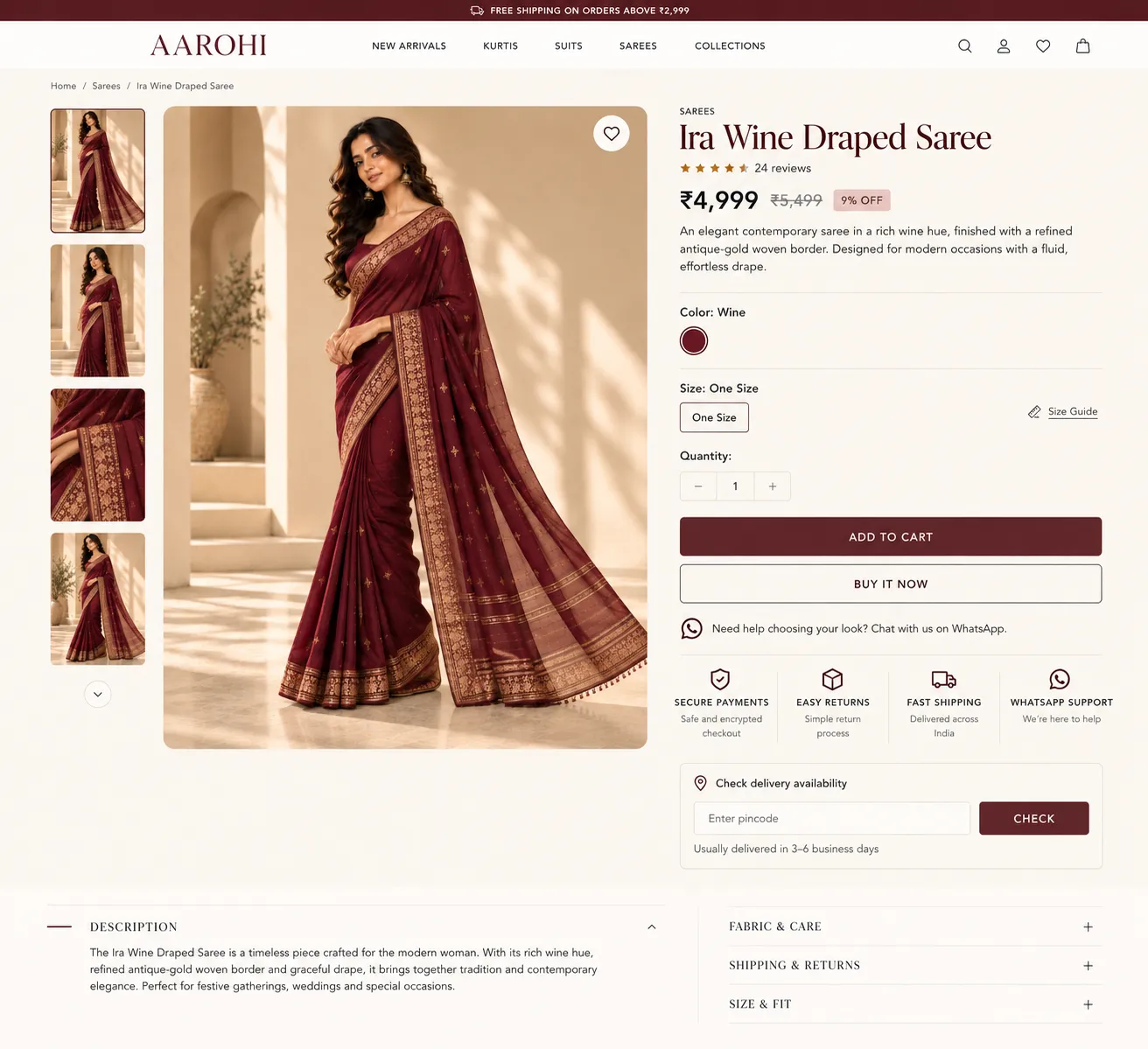
A fictional boutique storefront created to demonstrate the type of commerce experience and system structure ADSTAZE can build.
Important: AAROHI is a fictional concept brand created for demonstration purposes. These visuals are not presented as results or work completed for a client.
Your storefront is built as your commerce asset — with clear ownership, transparent third-party costs and a structured handoff.
Your Shopify store, domain, theme licence and completed deliverables remain under your ownership after payment.
OWNERSHIPShopify, paid themes, apps, domain, payment gateway and courier charges are separate third-party costs — not hidden inside the build.
TRANSPARENCYOnce the store is ready, you receive the required access, walkthrough and implementation handoff to operate your storefront.
CONTROLADSTAZE handles the implementation. Your boutique keeps control of the commerce asset.
You provide the required product information, imagery, policies and third-party access. If required inputs are delayed, the implementation timeline pauses accordingly.
Clear answers to the questions boutique owners usually have before starting a storefront project.
A typical implementation takes around 7–10 working days after scope approval, required access, content lock and third-party onboarding are complete.
Yes. Product imagery, product information, variants, pricing and required business policies are provided by the boutique. The implementation timeline depends on receiving the required inputs.
The implementation is separate from Shopify's own subscription charges. Domain, paid themes, apps, payment gateway and courier-related costs are also separate third-party expenses where applicable.
The storefront can be configured around the relevant payment and COD setup. Actual payment gateway approval, account requirements and transaction charges are handled through the respective provider.
The core implementation uses a defined catalogue band agreed before the project begins. Larger catalogues, migrations or additional product uploads can be scoped separately.
Two consolidated revision rounds are included within the agreed scope. New functionality, additional pages or changes outside the agreed scope are handled separately.
Yes. The store, domain, theme licence and completed deliverables are intended to remain under the client's ownership after payment, subject to the applicable third-party licences and accounts.
No. The project is focused on building the commerce foundation and launch-ready storefront. Sales, revenue, ROAS, conversion rate and other business outcomes depend on factors beyond the implementation itself.
You receive the launch handoff and walkthrough. The implementation also includes a 21-day bug-fix window for issues related to the delivered implementation. New features or content changes are separate.
I'm the founder of ADSTAZE, where I work at the intersection of performance marketing, conversion systems and e-commerce growth.
My focus is simple — help businesses get discovered, convert more of that attention into customers, and build digital systems they can actually grow with.

Now give that attention somewhere to go. Build a storefront you own, a commerce journey you can measure, and a foundation you can grow from.
Mobile-first implementation
Clear project scope
Structured launch handoff
Built for future acquisition